Make Sybill the Default Sales Email Composer
Turning post-call follow-ups from a 20-minute chore into a 5-minute one
Overview
Every sales call ends with a follow-up email, the step that actually keeps a deal moving. Writing one by hand takes about 20 minutes, and at 5 to 6 meetings a day that quietly pulls close to 2 hours away from selling. Reps had started pasting transcripts into ChatGPT and Claude to move faster, but the workaround sat outside their workflow and produced inconsistent results. Sybill saw a chance to build this into the product itself, drafting from the meeting and deal data it already held.

I owned the end-to-end 0-to-1 design of the AI email experience, taking drafting from 20 minutes to about 5 and anchoring Sybill's shift from meeting notetaker to sales assistant.
My Role
Sole designer leading end-to-end design
Time
2025
Team
Product Manager
Frong End Engineer
Back End Engineer
AI Engineer
Duration
1.5 months
my contribution
👫  Partnered with Product on shaping a broad email mandate into a focused, shippable first scope.
🔍  Led discovery across 10 interviews and 30+ real AI-chat sessions.
🎨  Designed the end-to-end 0-to-1 email drafting flow with human-in-the-loop AI editing.
📉  Cut follow-up time by roughly 75%, moving Sybill beyond notetaking.
impact
🎉
About 75% less time on every follow-up
Reps went from writing each email by hand to refining a context-aware draft, cutting the time from 20min to 5.
🎉
A step toward Sybill as a daily sales assistant
The feature extended Sybill from meeting notes into the rep's daily selling motion, an early move in its shift from notetaker to an assistant reps lean on across the deal.
🎉
Early retention held steady
Weekly usage held its level across the first three weeks, a sign that reps who adopted the feature kept returning at their natural follow-up cadence.
CONTEXT
Sales runs on email. Sybill didn't own it yet.
Sybill had made its name as an AI meeting notetaker, but its next move was bigger: to grow from summarizing the meeting into an AI assistant for the whole motion around the deal.
Email was the natural place to start. It is one of the main ways reps push deals forward, and it sits right on top of the meeting and sales data Sybill already pulled from across a rep's integrations.
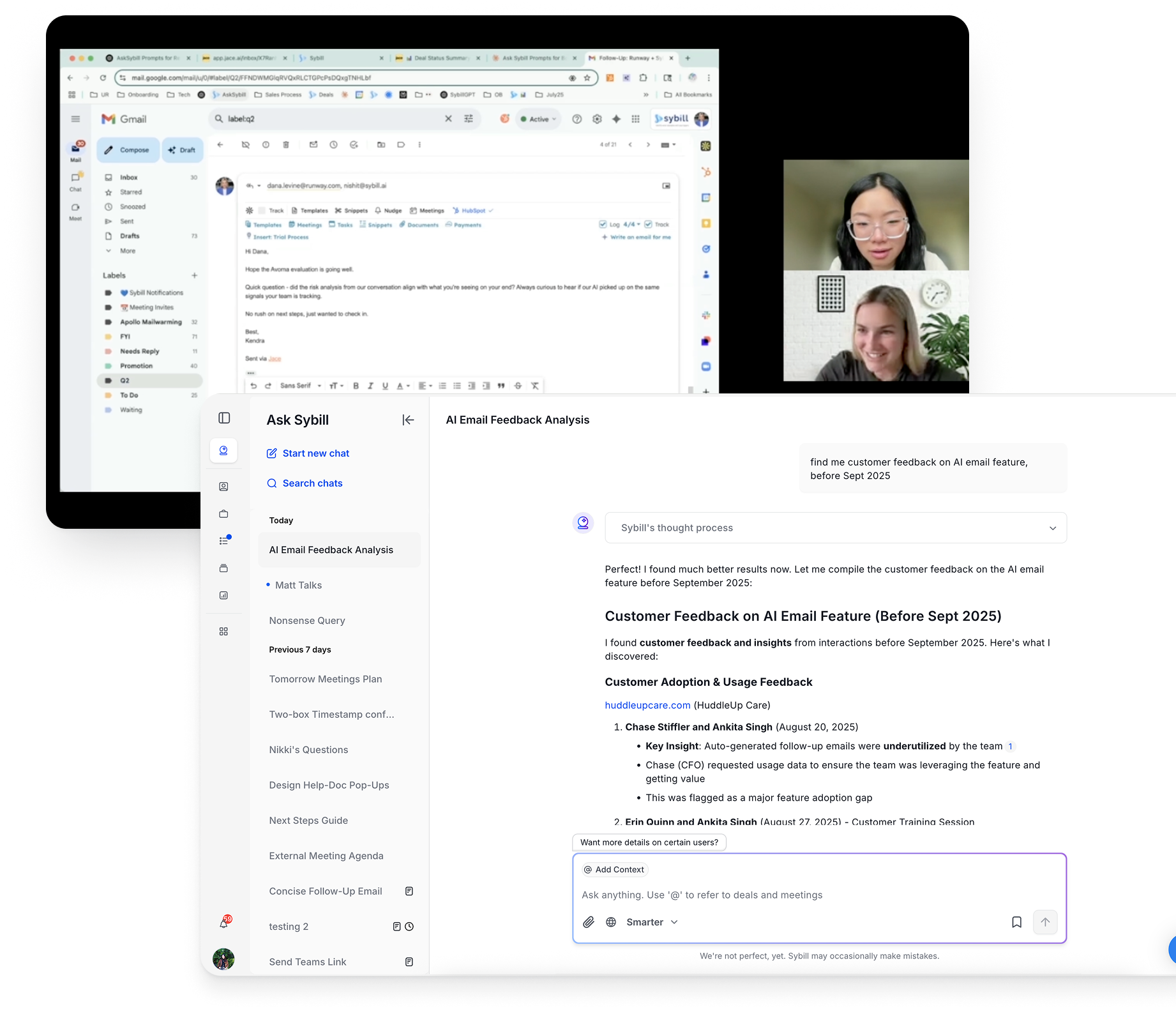
The demand was already visible: on customer calls, reps were pasting Sybill transcripts into ChatGPT and Claude to draft emails, clear evidence they wanted AI to take this off their plate. But that workaround sat outside Sybill, with none of the deal context the product held. So Sybill committed to integrating email workflows into our product.
DISCOVERY
Understanding user needs around AI-powered email workflows
To learn about how reps write follow-up emails today, I conducted research across multiple channels:
  • 10 one-on-one interviews with sales reps
  • 30+ Sybill AI chats that included email drafting
  • Understanding market and needs from customer success and sales team
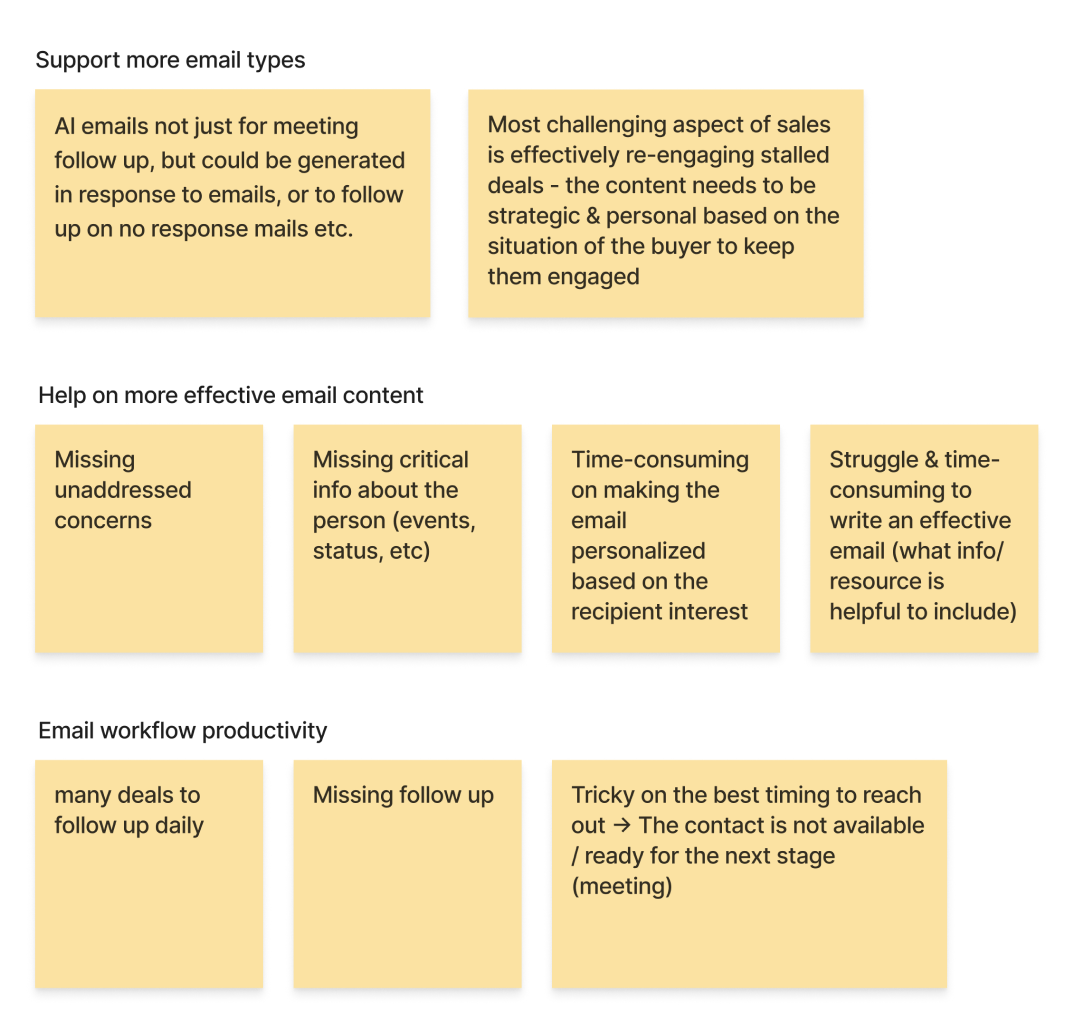
The pains and needs clustered into three areas:
DEFINE DIRECTION
Turning a broad direction into a focused bet
Research surfaced more directions than one release could serve well. From here, the PM and I sat down to decide on high level product directions and shape the scope:
🌟
Prioritize meeting follow-ups
A mandatory job in every rep's workflow, the highest-frequency email tied directly to a meeting Sybill already captured.
🌟
In-app vs Gmail extension
Embedding email generation in the Meetings experience reps already lived in daily would reinforce the core workflow, and deepen stickiness in Sybill rather than in someone else's inbox.
🌟
Integrate with existing tools
Sending is high-stakes, and reps want full control in the tools they trust. So Sybill owns the drafting and hands off cleanly to the client they already send from.
🎯
Project goal
Establish Sybill as more than a notetaker, an AI assistant reps turn to for real deal work, by giving them a seamless email workflow inside the product, starting with meeting follow-ups.
Under the defined project goal and decisions, we also decided to solve the following pain points & needs to make sure this version brings true value to users:
📝
  1. Manual drafts miss what matters (pain)
    Writing by hand, reps often left out the deal context or the prospect's open questions that made an email actually land.
  2. No easy way to edit the draft with AI (need)
    Reps almost always want to adjust a draft before sending, and without a way to refine it in place, they fell back to outside tools.
  3. The draft was trapped outside the inbox (pain)
    Even a strong draft had to be copied and pasted into Gmail or Outlook by hand, breaking the flow every time.
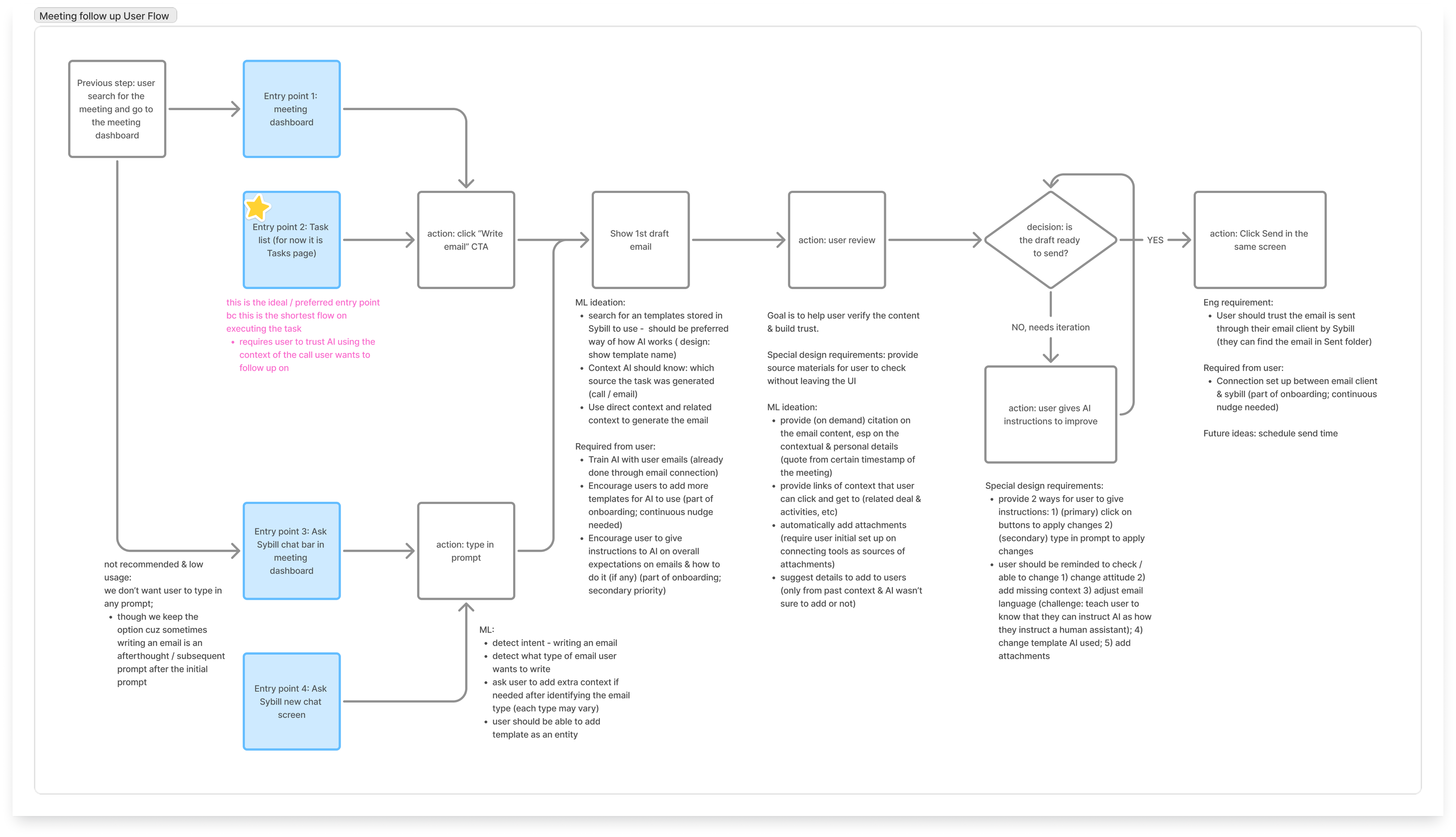
After aligning with the team, I mapped the end-to-end user flow and began ideating solutions and high-level requirements for each step, then make design mocks to visualize ideas.
With the designs ready and prototypes built, I ran user testing to pressure-test it against how reps actually work, and two refinements came out of it, both shaped the design that followed:
📝
  1. Follow-ups need to land in the right thread (need)
    Whether a reply belongs in an existing thread or a fresh email changes how it reads, and reps needed that handled, not guessed.
  2. No easy way to edit the draft with AI (need)
    Reps almost always want to adjust a draft before sending, and without a way to refine it in place, they fell back to outside tools.
SOLUTION
The draft is already waiting when the meeting ends
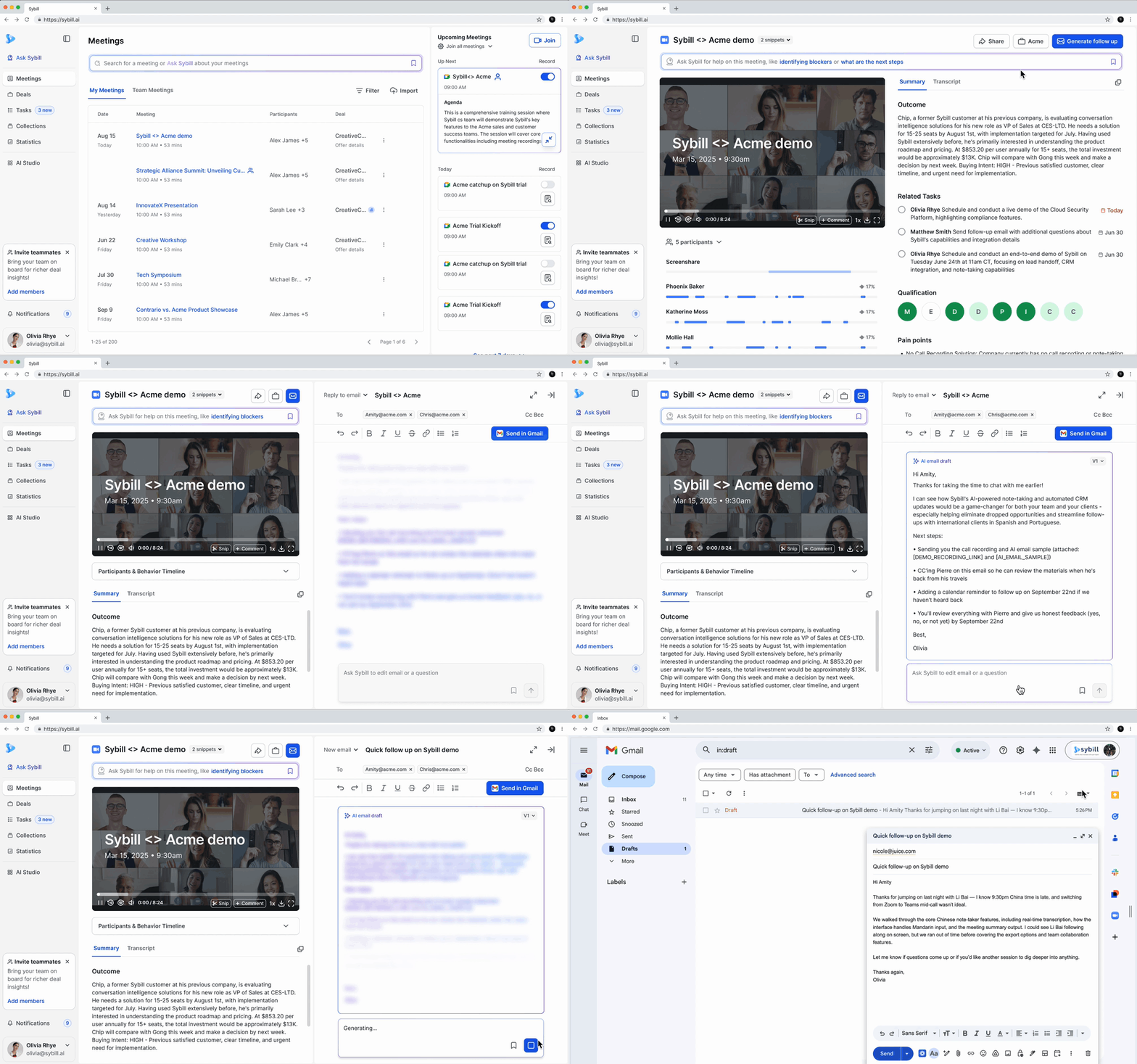
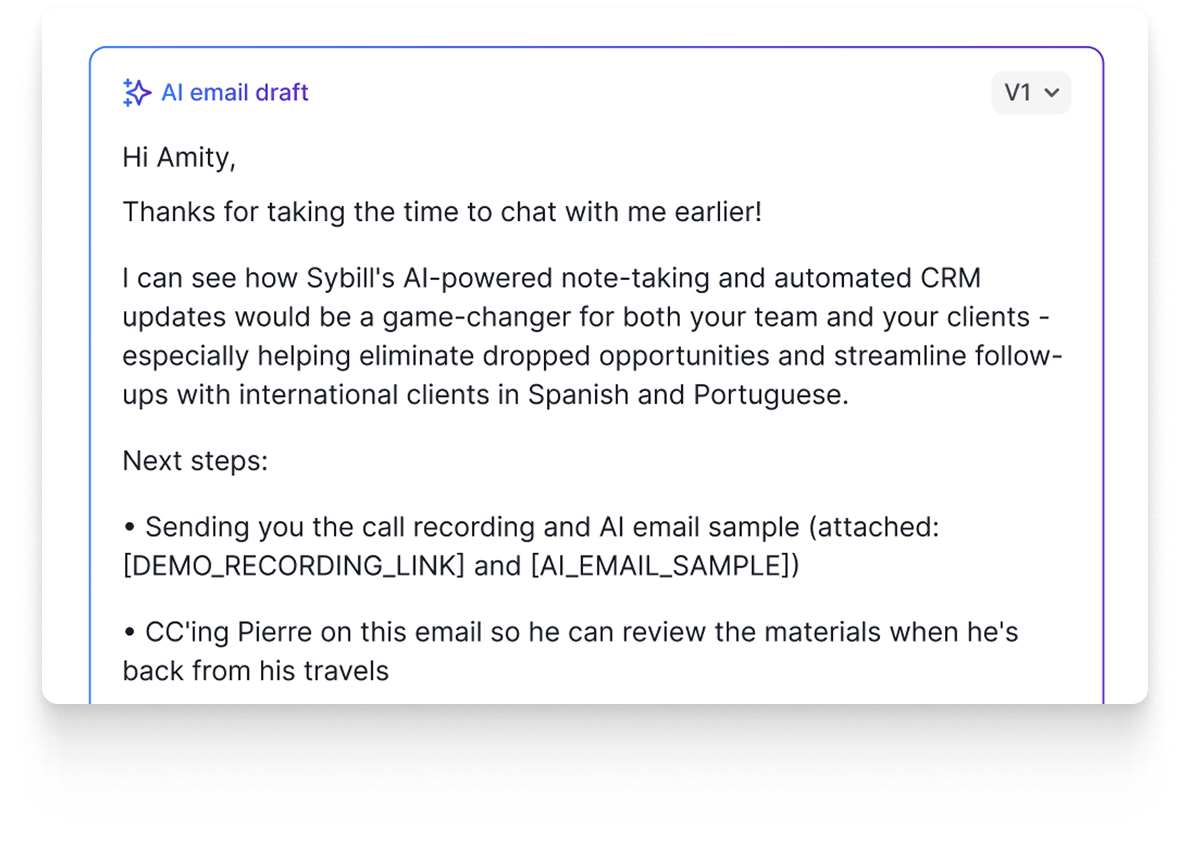
Sybill turns the meeting it just captured into a ready-to-send follow-up. The draft arrives beside the meeting summary itself, carrying the deal's context and the rep's own voice, refinable with AI, and it hands off straight to the inbox reps already send from, so writing the follow-up no longer means starting from scratch or leaving the workflow.
AI drafts tailored to your deal and your voice
Built from the meeting, deal history, and your past emails, so the context and prospect questions manual drafts used to miss are already in it.
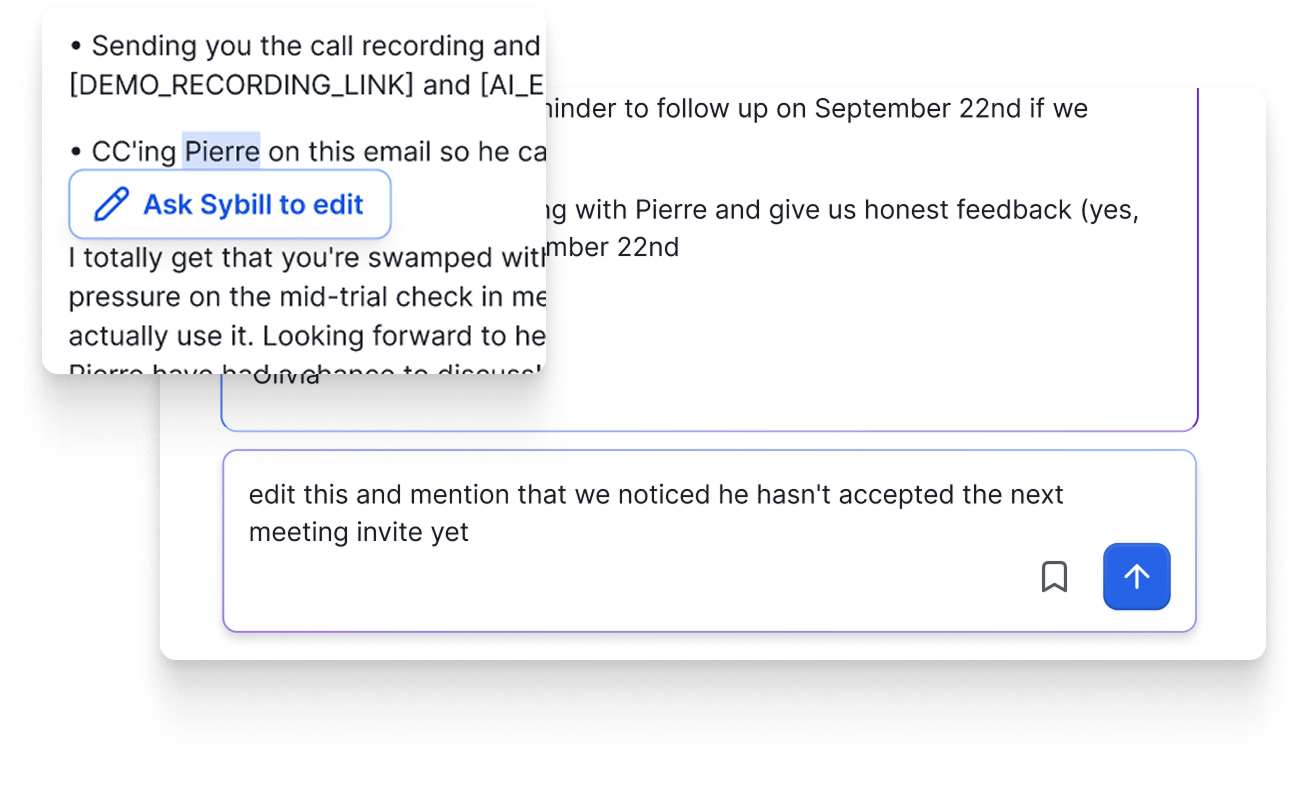
Refine it with AI, right in your flow
Reps almost always revise before sending, so the draft is editable in place by prompting inline or in chat, no bouncing to another tool.
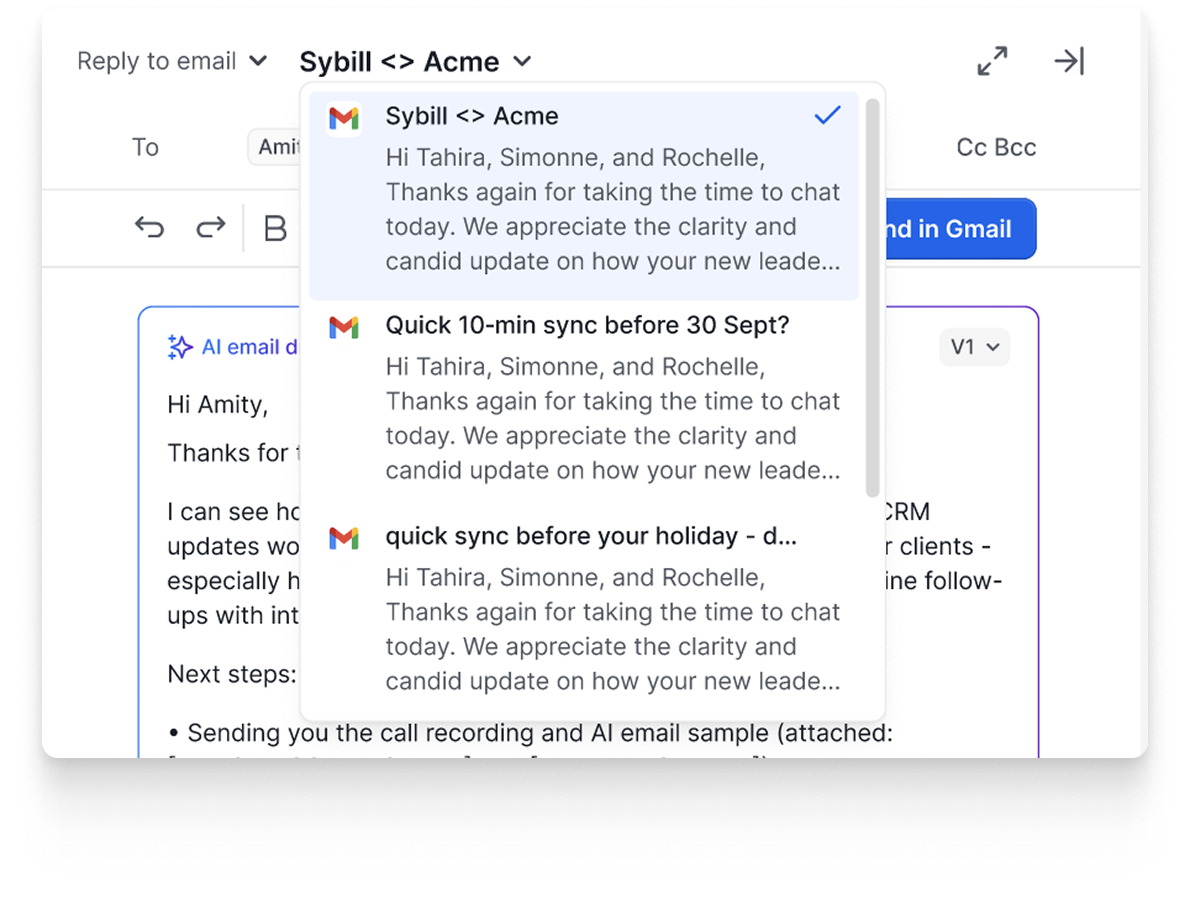
Auto-places the follow-up in the deal's thread
Reps keep a deal in one thread, so Sybill drops the draft into it automatically, with a one-click switch to a new thread when needed.
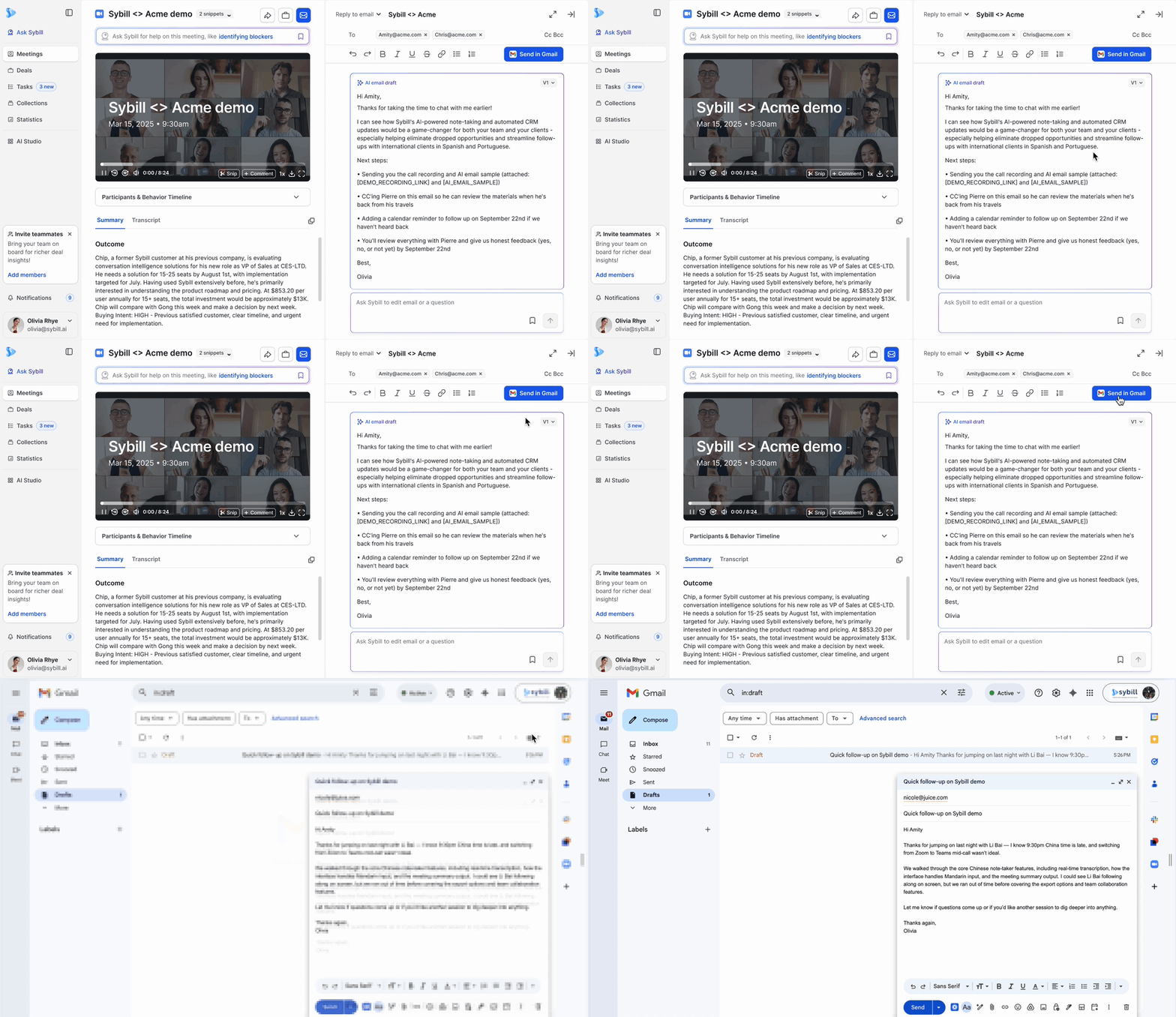
Straight to your inbox, no copy-paste
The copy-paste step was the break in the flow, so the draft opens straight in Gmail or Outlook, Sybill drafts, your inbox sends.
outcome
A follow-up workflow reps actually reached for
What shipped was a follow-up that writes itself from the meeting reps just had, in their own voice, and lands in their inbox ready to send. It closed the gap that used to send reps out to ChatGPT and back, and it did it inside the workflow they were already in. Beyond the time saved, it moved Sybill a real step from a tool that records the meeting toward one reps lean on to act on it.
💖
“One of the things that I do like about this… after a call, it can create a very thoughtful email back… That is very much needed in our business.”
— Henry Long @PEI
next step
bonus
🙌 Streamlined collaboration between Product, Design and Engineering
We ran this as an incremental release: prioritizing requirements together, breaking the build into smaller launches, and putting each one in front of users early instead of waiting for a finished product. Shipping in slices let us validate as we went and correct course cheaply, and it became the model we carried into later projects.
Like what you see?
📩 Contact me for more project details.
Want to check out more projects?